
119 lines
3.3 KiB
Markdown
119 lines
3.3 KiB
Markdown
##[$AcWing$ $1316$. 有趣的数列](https://www.acwing.com/problem/content/description/1318/)
|
||
|
||
### 一、题目描述
|
||
我们称一个长度为 $2n$ 的数列是有趣的,当且仅当该数列满足以下三个条件:
|
||
|
||
- 它是从 $1$ 到 $2n$ 共 $2n$ 个整数的一个排列 ${a_i}$
|
||
|
||
- 所有的 **奇数项** 满足 $a_1<a_3<⋯<a_{2n−1}$,所有的 **偶数项** 满足 $a_2<a_4<⋯<a_{2n}$
|
||
|
||
- 任意相邻的两项 $a_{2i−1}$ 与 $a_{2i}$ $(1≤i≤n)$ 满足奇数项小于偶数项,即:$a_{2i−1}<a_{2i}$
|
||
|
||
任务是:对于给定的 $n$,请求出有多少个不同的长度为 $2n$ 的有趣的数列。
|
||
|
||
因为最后的答案可能很大,所以只要求输出答案 $mod$ $P$的值。
|
||
|
||
**输入格式**
|
||
|
||
只包含用空格隔开的两个整数 $n$ 和 $P$。
|
||
|
||
**输出格式**
|
||
|
||
仅含一个整数,表示不同的长度为 $2n$ 的有趣的数列个数 $mod$ $P$ 的值。
|
||
|
||
**数据范围**
|
||
|
||
$1≤n≤10^6,2≤P≤10^9$
|
||
|
||
**输入样例**
|
||
```cpp {.line-numbers}
|
||
3 10
|
||
```
|
||
**输出样例:**
|
||
```cpp {.line-numbers}
|
||
5
|
||
```
|
||
|
||
**样例解释**
|
||
|
||
对应的 $5$ 个有趣的数列分别为 $\{1,2,3,4,5,6\},\{1,2,3,5,4,6\},\{1,3,2,4,5,6\},\{1,3,2,5,4,6\},\{1,4,2,5,3,6\}$。
|
||
|
||
|
||
### 二、解题思路
|
||
|
||
**[嘉持老师的优秀教学视频](https://www.bilibili.com/video/BV1nE411A7ST)**
|
||
|
||
|
||
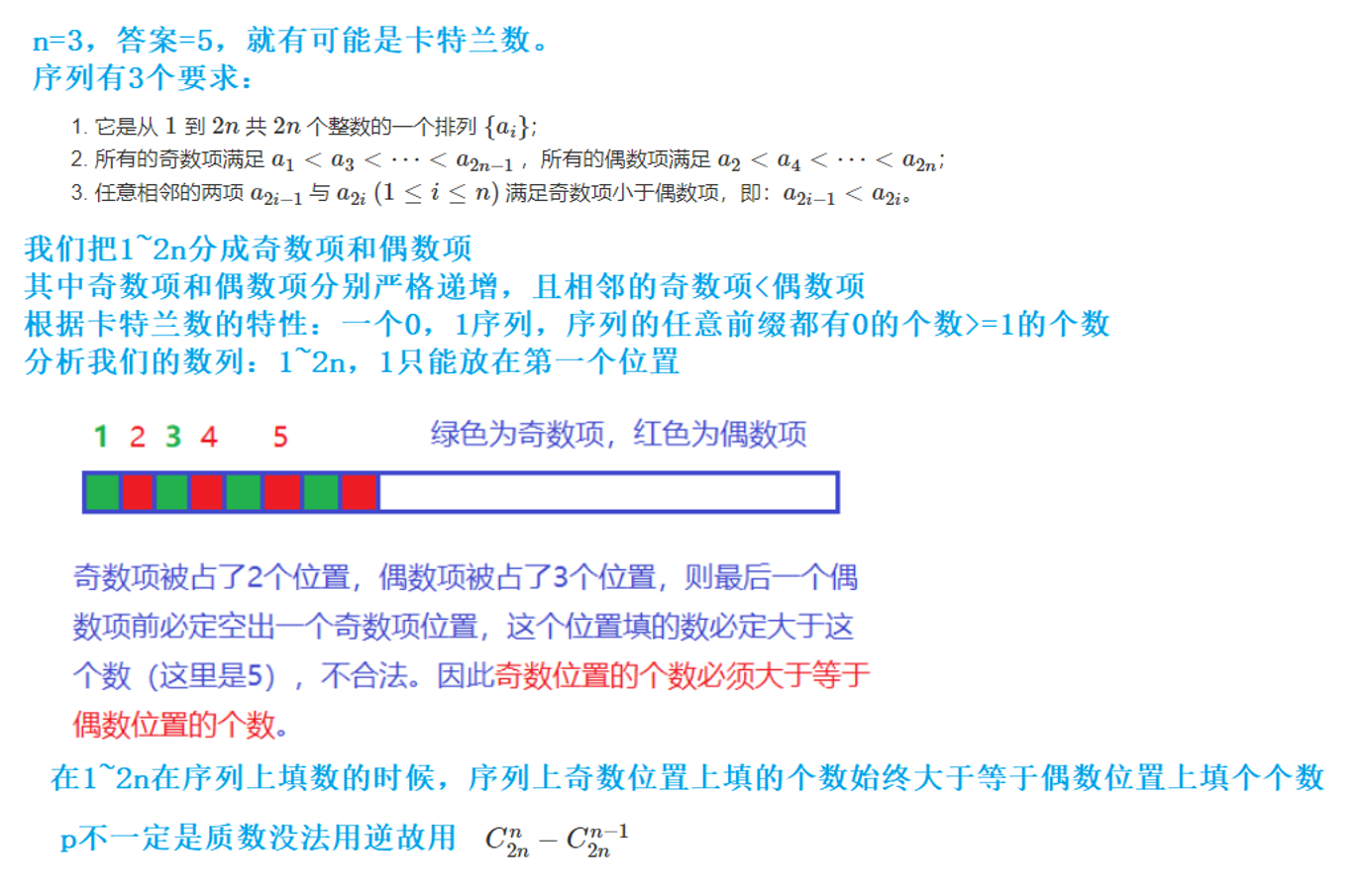
我们要有这种直觉:一旦发现输入是$3$,输出是$5$,很可能就是 **卡特兰数**。关于卡特兰数的讲解可以参考:**[网址](https://blog.csdn.net/weixin_42638946/article/details/115751984)**。
|
||
|
||
|
||
**如何判断某个问题是不是卡特兰数呢?一般由两种方式:**
|
||
|
||
- ① 能得到公式:$$\large f(n)=f(0) \times f(n-1) + f(1) \times f(n-2) + ... +f(n-1)\times f(0)$$
|
||
> **解释**:联想一下嘉持老师的画二叉树,就是向左子树分配$i$个节点,那么向右子树就分配$n-i-1$个节点,因为根点了一个节点。
|
||
|
||
- ② 能挖掘出如下性质:任意前缀中,某种东西的数量 ≥ 另一种东西数量。
|
||
|
||
|
||
|
||
|
||
组合数等于三个阶乘相乘除,因此我们求出各个阶乘的质因数分解,就能得到组合数的模$p$后大小。
|
||
|
||
### 三、实现代码
|
||
|
||
```cpp {.line-numbers}
|
||
#include <bits/stdc++.h>
|
||
using namespace std;
|
||
#define int long long
|
||
#define endl "\n"
|
||
const int N = 2000010;
|
||
|
||
int n, mod;
|
||
int primes[N], cnt;
|
||
bool st[N];
|
||
|
||
void get_primes(int n) {
|
||
for (int i = 2; i <= n; i++) {
|
||
if (!st[i]) primes[cnt++] = i;
|
||
for (int j = 0; primes[j] * i <= n; j++) {
|
||
st[i * primes[j]] = true;
|
||
if (i % primes[j] == 0) break;
|
||
}
|
||
}
|
||
}
|
||
|
||
int qmi(int a, int k) {
|
||
int res = 1;
|
||
while (k) {
|
||
if (k & 1) res = res * a % mod;
|
||
a = a * a % mod;
|
||
k >>= 1;
|
||
}
|
||
return res;
|
||
}
|
||
|
||
int get(int n, int p) {
|
||
int s = 0;
|
||
while (n) {
|
||
s += n / p;
|
||
n /= p;
|
||
}
|
||
return s;
|
||
}
|
||
|
||
int C(int a, int b) {
|
||
int res = 1;
|
||
for (int i = 0; i < cnt; i++) {
|
||
int p = primes[i];
|
||
int s = get(a, p) - get(b, p) - get(a - b, p);
|
||
res = res * qmi(p, s) % mod;
|
||
}
|
||
return res;
|
||
}
|
||
|
||
signed main() {
|
||
cin >> n >> mod;
|
||
get_primes(n * 2);
|
||
cout << (C(n * 2, n) - C(n * 2, n - 1) + mod) % mod << endl;
|
||
}
|
||
``` |