
204 lines
6.2 KiB
Markdown
204 lines
6.2 KiB
Markdown
## [$AcWing$ $802$. 区间和 ](https://www.acwing.com/problem/content/804/)
|
||
|
||
### 一、题目描述
|
||
假定有一个无限长的数轴,数轴上每个坐标上的数都是 $0$。
|
||
|
||
现在,我们首先进行 $n$ 次操作,每次操作将某一位置 $x$ 上的数加 $c$。
|
||
|
||
接下来,进行 $m$ 次询问,每个询问包含两个整数 $l$ 和 $r$,你需要求出在**区间 $[l,r]$ 之间的所有数的和**。
|
||
|
||
**输入格式**
|
||
第一行包含两个整数 $n$ 和 $m$。
|
||
|
||
接下来 $n$ 行,每行包含两个整数 $x$ 和 $c$。
|
||
|
||
再接下来 $m$ 行,每行包含两个整数 $l$ 和 $r$。
|
||
|
||
**输出格式**
|
||
共 $m$ 行,每行输出一个询问中所求的区间内数字和。
|
||
|
||
**数据范围**
|
||
$−10^9≤x≤10^9$,
|
||
$1≤n,m≤10^5$,
|
||
$−10^9≤l≤r≤10^9$,
|
||
$−10000≤c≤10000$
|
||
|
||
**输入样例:**
|
||
```cpp {.line-numbers}
|
||
3 3
|
||
1 2
|
||
3 6
|
||
7 5
|
||
1 3
|
||
4 6
|
||
7 8
|
||
```
|
||
|
||
**输出样例:**
|
||
```cpp {.line-numbers}
|
||
8
|
||
0
|
||
5
|
||
```
|
||
|
||
|
||
|
||
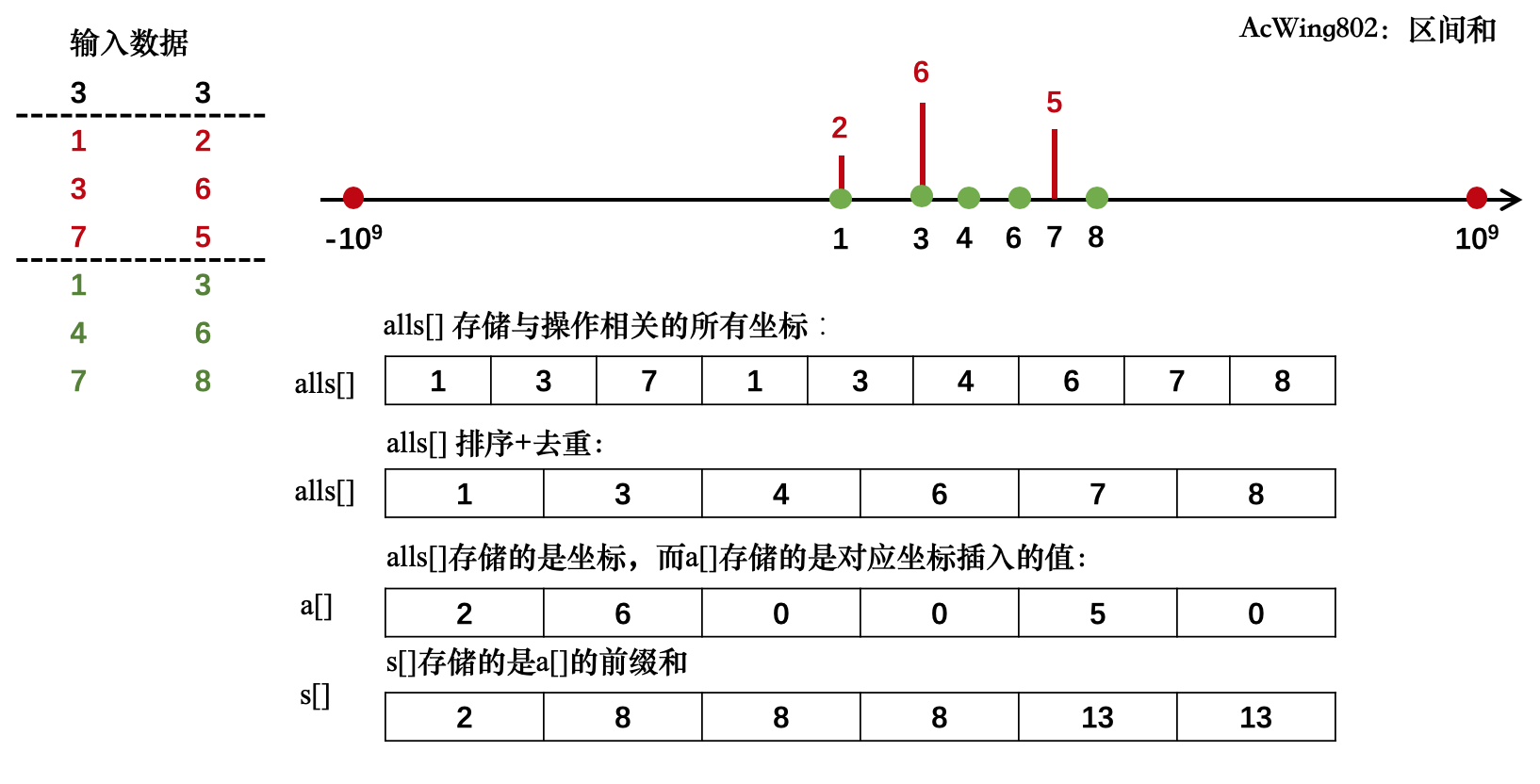
**特殊说明一下,$alls$数组下标是从$0$开始的,而$a$数组下标是从$1$开始的,$alls$数组与$a$数组是一一对应的,但是错位对应的,即$alls[0]->a[1],alls[1]->a[2],....$**
|
||
|
||
### 二、解题思路
|
||
|
||
1. **为什么要离散化**?
|
||
因为 **[空间上不允许开那么大数据范围的数组](https://www.cnblogs.com/littlehb/p/15304297.html)** !本题$−{10}^9≤x≤10^9$,,两边都加上就是$2*10^9$,$c++$开不到$3e7$以上,空间超限。
|
||
|
||
2. **什么是离散化**?
|
||
**离散化**:范围大,但比较稀疏,真正有数的不多,很多地方是空着的(空着的是0)。利用这一特点,把有用的位置 **映射** 到一个长度可控的范围上。
|
||
|
||
3. **数组大小的确定**
|
||
既然要映射到一块小的、能装的下的区域内,那么这个区域最大是多大呢?
|
||
因为原始数据坐标共$n$个,而查询时坐标是$[l,r]$,一次两个,一共$m$次,需要把所有的坐标全部放到$a$数组中,上限是:$n+2*m$,依题意,就是$3*1e5$
|
||
|
||
4. **离散化模板**
|
||
```c++
|
||
// ① 排序+去重
|
||
sort(a, a + al);
|
||
// ② 使用STL的去重函数去重,不用手写的去重,原因:只排序一次,去重一次,不像是二分需要重复使用,性能差另不大,但代码就短的多
|
||
al = unique(a, a + al) - a;
|
||
```
|
||
|
||
### 三、模板代码
|
||
```cpp {.line-numbers}
|
||
#include <bits/stdc++.h>
|
||
|
||
using namespace std;
|
||
typedef pair<int, int> PII;
|
||
|
||
const int N = 300010;
|
||
int a[N], al;
|
||
int b[N], s[N]; // 假定有一个无限长的数轴,数轴上每个坐标上的数都是 0
|
||
|
||
PII q[N], p[N];
|
||
int ql, pl;
|
||
|
||
int n, m;
|
||
|
||
// 手写二分
|
||
int lower_bound(int q[], int l, int r, int x) {
|
||
while (l < r) {
|
||
int mid = (l + r) >> 1;
|
||
if (q[mid] >= x)
|
||
r = mid;
|
||
else
|
||
l = mid + 1;
|
||
}
|
||
return l;
|
||
}
|
||
|
||
int main() {
|
||
cin >> n >> m;
|
||
while (n--) {
|
||
int x, c;
|
||
cin >> x >> c;
|
||
p[pl++] = {x, c};
|
||
a[al++] = x;
|
||
}
|
||
|
||
int l, r;
|
||
while (m--) {
|
||
cin >> l >> r;
|
||
q[ql++] = {l, r};
|
||
a[al++] = l, a[al++] = r;
|
||
}
|
||
|
||
// ① 排序+去重
|
||
sort(a, a + al);
|
||
// ② 使用STL的去重函数去重,不用手写的去重,原因:只排序一次,去重一次,不像是二分需要重复使用,性能差别不大,但代码就短的多
|
||
al = unique(a, a + al) - a;
|
||
|
||
// 处理一下某个x上加c的事情
|
||
for (int i = 0; i < pl; i++) {
|
||
int x = lower_bound(a, 0, al, p[i].first) + 1; // 下标从0开始,需要加1个偏移量
|
||
b[x] += p[i].second;
|
||
}
|
||
|
||
// 一维前缀和
|
||
for (int i = 1; i < N; i++) s[i] = s[i - 1] + b[i];
|
||
|
||
// 处理询问(前缀和应用)
|
||
for (int i = 0; i < ql; i++) {
|
||
// 根据原来的位置值,计算出映射后的位置值
|
||
l = lower_bound(a, 0, al, q[i].first) + 1;
|
||
r = lower_bound(a, 0, al, q[i].second) + 1;
|
||
// 利用一维前缀和计算区间和
|
||
printf("%d\n", s[r] - s[l - 1]);
|
||
}
|
||
return 0;
|
||
}
|
||
```
|
||
### 四、总结
|
||
- 提到的所有位置点,不管是有数值的点,还要是查询的点,统统记录到$a[]$数组中
|
||
- 对$a$数组进行排序+去重操作
|
||
- 遍历每一个有值的点,通过二分将原坐标变换为新的坐标,使用一个基础数组$b[]$,记录新坐标中对应的数值
|
||
- 对基础数组$b$生成前缀和数组$s[]$
|
||
- 利用前缀和数组$s[]$回答问题
|
||
|
||
### 五、完全使用$STL$的代码实现
|
||
|
||
> 因为多次调用二分算法,手工与$STL$的性能差距放大了~
|
||
|
||
```cpp {.line-numbers}
|
||
#include <bits/stdc++.h>
|
||
|
||
using namespace std;
|
||
typedef pair<int, int> PII;
|
||
|
||
const int N = 300010;
|
||
int a[N], al;
|
||
int b[N], s[N]; // 假定有一个无限长的数轴,数轴上每个坐标上的数都是 0
|
||
|
||
PII q[N], p[N];
|
||
int ql, pl;
|
||
|
||
int n, m;
|
||
|
||
int main() {
|
||
cin >> n >> m;
|
||
while (n--) {
|
||
int x, c;
|
||
cin >> x >> c;
|
||
p[pl++] = {x, c};
|
||
a[al++] = x;
|
||
}
|
||
|
||
int l, r;
|
||
while (m--) {
|
||
cin >> l >> r;
|
||
q[ql++] = {l, r};
|
||
a[al++] = l, a[al++] = r;
|
||
}
|
||
|
||
// ① 排序+去重
|
||
sort(a, a + al);
|
||
// ② 使用STL的去重函数去重,不用手写的去重,原因:只排序一次,去重一次,不像是二分需要重复使用,性能差别不大,但代码就短的多
|
||
al = unique(a, a + al) - a;
|
||
|
||
// 处理一下某个x上加c的事情
|
||
for (int i = 0; i < pl; i++) {
|
||
int x = lower_bound(a,a+ al, p[i].first)-a + 1; // 下标从0开始,需要加1个偏移量
|
||
b[x] += p[i].second;
|
||
}
|
||
|
||
// 一维前缀和
|
||
for (int i = 1; i < N; i++) s[i] = s[i - 1] + b[i];
|
||
|
||
// 处理询问(前缀和应用)
|
||
for (int i = 0; i < ql; i++) {
|
||
// 根据原来的位置值,计算出映射后的位置值
|
||
l = lower_bound(a, a+ al, q[i].first)-a + 1;
|
||
r = lower_bound(a, a+ al, q[i].second)-a + 1;
|
||
// 利用一维前缀和计算区间和
|
||
printf("%d\n", s[r] - s[l - 1]);
|
||
}
|
||
return 0;
|
||
}
|
||
```
|
||
 |