
138 lines
3.8 KiB
Markdown
138 lines
3.8 KiB
Markdown
## [$AcWing$ $3549$. 最长非递减子序列 ](https://www.acwing.com/problem/content/description/3552/)
|
||
|
||
### 一、题目描述
|
||
给定一个长度为 $n$ 的数字序列 $a_1,a_2,…,a_n$,序列中只包含数字 $1$ 和 $2$。
|
||
|
||
现在,你要选取一个区间 $[l,r](1≤l≤r≤n)$,将 $a_l,a_{l+1},…,a_r$ 进行翻转,并且使得到的新数字序列 $a$ 的最长非递减子序列的长度尽可能长。
|
||
|
||
请问,这个最大可能长度是多少?
|
||
|
||
一个非递减子序列是指一个索引为 $p_1,p_2,…,p_k$的序列,满足 $p_1<p_2<…<p_k$ 并且 $a_{p1}≤a_{p2}≤…≤a_{pk}$,其长度为 $k$。
|
||
|
||
**输入格式**
|
||
|
||
第一行一个整数 $n$。
|
||
|
||
第二行 $n$个空格隔开的数字 $1$ 或 $2$,表示 $a_1,…,a_n$。
|
||
|
||
**输出格式**
|
||
|
||
输出一个整数,表示得到的新数字序列 $a$ 的最长非递减子序列的最大可能长度。
|
||
|
||
**数据范围**
|
||
|
||
对于 $30\%$ 的数据,$1≤n≤100$。
|
||
对于 $100\%$ 的数据,$1≤n≤106$。
|
||
|
||
本题读入数据规模较大,需注意优化读入。
|
||
$C++$ 尽量使用 $scanf$ 读入,$Java$ 尽量使用 $BufferedReader$ 读入。
|
||
|
||
**输入样例**$1$:
|
||
```cpp {.line-numbers}
|
||
4
|
||
1 2 1 2
|
||
```
|
||
|
||
**输出样例1**:
|
||
```cpp {.line-numbers}
|
||
4
|
||
```
|
||
|
||
|
||
**输入样例2**:
|
||
```cpp {.line-numbers}
|
||
10
|
||
1 1 2 2 2 1 1 2 2 1
|
||
```
|
||
|
||
**输出样例2**:
|
||
```cpp {.line-numbers}
|
||
9
|
||
```
|
||
|
||
### 二、从简化题目出发(求只含12的序列长度)
|
||
|
||
首先我是考虑的求出该序列的最长非递减子序列
|
||
|
||
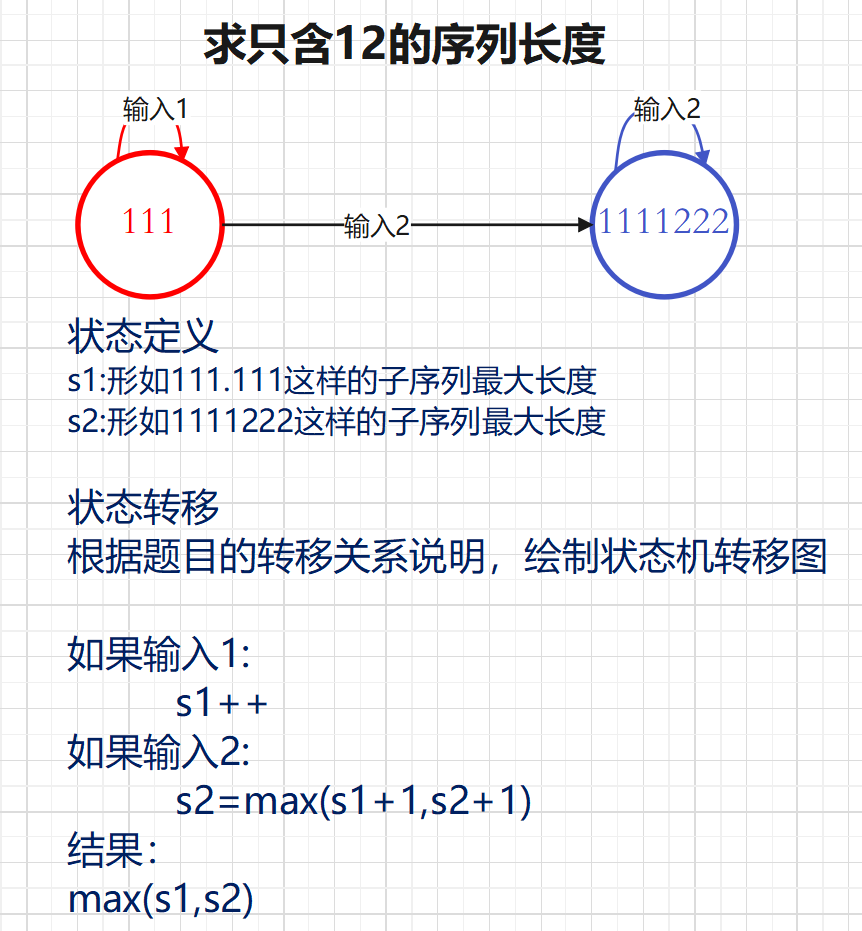
其实只有 $2$ 种状态
|
||
- $1111111$…
|
||
只可能由 $111111$… 这种状态转移而来
|
||
|
||
- $111111112222222222$…
|
||
可能由 $11111111$… 转移而来
|
||
也可能由 $111112222$… 转移而来
|
||
|
||
|
||
|
||
#### $Code$
|
||
```cpp {.line-numbers}
|
||
#include <bits/stdc++.h>
|
||
using namespace std;
|
||
|
||
int main() {
|
||
int n;
|
||
cin >> n;
|
||
int s1 = 0, s2 = 0;
|
||
while (n--) {
|
||
int x;
|
||
cin >> x;
|
||
if (x == 1) {
|
||
s1++; // 如果当前数字是 1,则状态1的长度加1
|
||
} else {
|
||
s2 = max(s1 + 1, s2 + 1); // 如果当前数字为2,可能由两种状态转移而来
|
||
}
|
||
}
|
||
cout << max(s1, s2) << endl;
|
||
return 0;
|
||
}
|
||
```
|
||
|
||
### 三、回归题目(包括反转)
|
||
|
||
对于本题目而言,比上述的简单模型多加了一个条件:可以进行反转操作。
|
||
|
||
这就意味着,我们可以求一个形如:$111111222222111111222222$的子序列,然后进行反转操作让其变成 $1111111112222222$…的子序列
|
||
|
||
现在我们开始枚举状态:
|
||
|
||
- $1111111$....
|
||
只能通过 $111111$…转移
|
||
|
||
- $(111111)2…$
|
||
可以通过 $1111111$… 转移(仅限于转移到 $111111111111..2$ 这种状态)
|
||
也可通过 $(11111)2222222$…转移
|
||
|
||
- $(111111122222)11111$…
|
||
可以通过 $11111111222222$… 转移(仅限于转移到 $11111112222222..1$ 状态)
|
||
也可以通过 $(111111122222)11111$…转移
|
||
|
||
- $(111111122222221111111)22222$…
|
||
- 可以通过 $(111112222)111$… 转移(仅限于转移到 $1111222222111111..2$ 状态)
|
||
- 也可以通过 $(111111122222221111111)22222$… 转移
|
||
|
||
#### $Code$
|
||
```cpp {.line-numbers}
|
||
#include <bits/stdc++.h>
|
||
using namespace std;
|
||
|
||
int main() {
|
||
// 加快读入
|
||
ios::sync_with_stdio(false), cin.tie(0);
|
||
int s1 = 0, s2 = 0, s3 = 0, s4 = 0;
|
||
int n;
|
||
cin >> n;
|
||
while (n--) {
|
||
int x;
|
||
cin >> x;
|
||
if (x == 1) {
|
||
s1++;
|
||
s3 = max(s2 + 1, s3 + 1);
|
||
} else {
|
||
s2 = max(s1 + 1, s2 + 1);
|
||
s4 = max(s3 + 1, s4 + 1);
|
||
}
|
||
}
|
||
cout << max({s1, s2, s3, s4}) << endl;
|
||
return 0;
|
||
}
|
||
``` |